Sunday, January 23, 2022

I Love Those Limericks

I went back to gather up a few of the limericks I've written and found a few. If you can get them just right they can say a lot with just five short lines.

***

 On Facebook he turns into a clone 

when the wrong politics make him groan. 

He'll just "copy and paste" 

to make us all taste 

another's words, but none of his own.

***

Sarah Palin gave out a squawk

when she dug down in her crock

Her son slugged his girl

so she gave this a whirl

by blaming it all on Barack.

***

There was a fellow in Mandan

who blew snow deep as his ashcan

he ran out of gas

so call him a crass

abominable snowman.

***

Here's a rumor to repeat

It's almost set in concrete

it''s about Biden

and how he'll widen

the road to banning meat.

(Fox news had to retract this rumor.)

***

Thoughts on turning seventy-nine:

for the shape I'm in, I'm feeling fine

some parts are gone

but I get along

and hope my brain's not in decline.

***

Biden chose Deb Haaland for this reason -

to direct affairs in the public region

She'll be a good fit

and I'll throw in this bit

she might like lefse, she's half Norwegian.

(She is a Native American chosen for Sec'y of Interior.)

***

There'll be more


Friday, January 21, 2022

A Little More Baseball


Probably the best pitch in baseball is a well-located fastball, so some say.  Several pitchers have said without it, their other pitches couldn’t be effective. The interesting thing about the fastball are the variations it has on its trajectory to the plate. Any of the major league batters can handle a fastball if that is all there is, so the pitchers develop a variety of pitches to mix it up.

Some throw it with more spin on the ball. Tyler Kepner in his book K: A History of Baseball in Ten Pitches writes, “Don Sutton threw a level plane fastball that Tim McCarver found impossible to hit squarely.” It didn’t sink, it actually will rise as some proponents argue. Warren Spahn said, “If you throw enough and put enough backspin on the pitch, you get a fastball that goes against gravity.”

Looking back on my limited knowledge of the game, I claim Sandy Koufax as my favorite. After a quick search on the internet for the best pitcher of all time one site named The Big Train as number one: Walter Johnson. His record includes over 3500 strikeouts and 110 shutouts. Another says Christy Mathewson should be at the top. He was one of the first five players inducted into the Baseball Hall of Fame.

  Some lists place Lefty Grove at the top, Nolan Ryan sits at the top of some, Cy Young gets favor, and on and on. Statistics, individual preferences, stories all enter in with naming people’s favorites. 

A random search on the internet found this video: “Top 10 Nastiest Pitches in MLB (Voted by players).” It shows pitchers throwing a variety of unhittable pitches, but number one was a slider and features Chris Sale with the Red Sox. Nasty is right.

We can talk about other pitches such as the splitter, curveball, screwball, sinker, and cutter, but I find “the wet one” or “the slippery pitch” of interest, i.e. the spitball. There’s a rather sad story about a pitcher who was good at throwing it, but when he admitted to it, it cost him dearly. Apparently, those who throw one don’t want to admit it, but Preacher Roe wanted that $2000 the Sports Illustrated in 1955 offered him to talk about his using the spitball.  

The story goes like this. A few players were sitting around talking and Preacher Roe reportedly   asked their opinion as to whether he should go ahead with the interview. The extra money would pay for some repairs on his house. Most of them told him to go ahead, that is except for Carl Erskine who disagreed, although he didn’t speak up. Roe did the article, received his payment but finally realized what it cost him. Later he spoke with Erskine admitting it ruined his chances for being voted into the Hall of Fame.

The pitch was outlawed in 1920, but pitchers have found a variety of ways to disguise its use. Probably the most famous “modern day” spitballer is Gaylord Perry. Perry denied throwing the spitter as a player, but he titled his autobiography Me and the Spitter. Perry confessed that he’d even put Vaseline on his pants zipper because umpires would never check there. Unlike Preacher Roe, Perry is in the Hall of Fame.

Scuffed balls are in the same category as the wet one. The mud ball enters into the vocabulary, too, when a pitcher tries to get a little dirt clinging to the ball. Kepner quotes Warren Spahn regarding game 5 of the 1957 World Series: “Did you ever notice how many times Whitey (i.e. Ford) used to tie his shoelace during the game? Because Lew Burdette taught him to throw a mudball. And he’d wet the ball and put it on the ground and it was a little heavier on one side than the other, and he’d make the ball move because of that.”


Spahn related as to not having luck with throwing the spitball and used it just once where he gave up a homerun. Burdette tried instructing him, “You got to have two wet fingers and a dry thumb.” These athletes are so competitive that some will try anything to get an edge against the batter.

It has just been pitchers who’ve gotten the attention on these couple of past articles. None of the fielders or the batters received attention. They will have to wait until another time. Baseball carries a rich heritage in this country. Its origin is a bit unclear but a sportswriter named Henry Chadwick is often called the "Father of Baseball" for his early reporting on and contributions to the development of the game.

We’ve heard a great deal about Abner Doubleday being the inventor of baseball, but it’s more complicated than that. Some historians say its ancestry reaches into the 18th century as played in two English games - rounders and cricket. Whatever its lineage and history, it’s a sport loved by many people in the U.S.

We’ll end with a few facts gleaned from various sources, such as the first baseball game was held on June 19, 1846. Called the first because it was played according to the Knickerbocker’s Twenty Rules of baseball which included three outs per inning. Game 4 of the 1971 World Series was the first scheduled World Series game to be played at night. 

In 1929, the New York Yankees and the Cleveland Indians started their seasons with uniform numbers on their jerseys. Since the Yankees were rained out on opening day, so honors fell to the Indians becoming the first MLB team to wear numbers in a game. 

The song “Take Me Out to the Ball Game” was written in 1908 and has become the unofficial anthem of American baseball. And we’ll conclude with this. The longest game of baseball was 25 innings between the Milwaukee Brewers and the Chicago White Sox on May 8, 1984. The White Sox won by a score of 7-6. The game was stopped after 17 innings with the score tied 3-3 so the two teams could rest. The game finally ended in the 25th inning with a Harold Baines home run. 

Monday, January 17, 2022

Thinking Baseball

 I’m thinking baseball again. It is a rich topic full of stories, statistics, and players. After running across a baseball story that made me laugh out loud, I decided to pass it along and add a few more. This one adds comic relief in the serious business of pennant pursuit. Here’s the story.

Hard throwing Nolan Ryan pitched 27 seasons for four different teams and earned the record for pitching the all-time high of seven no-hit games.  During that career he tallied another all-time  record of 5,714 strike-outs. Feared by batters who knew he was capable of throwing inside pitches to brush them back from the plate, some even accused him of intentionally hitting batters. 

Ryan ended his career with an injury on September 22, 1993, and our story here took place a scant six weeks before that. Facing the White Sox batter Robin Ventura, Ryan’s pitch hit him on the arm. It prompted Ventura to charge the mound with the apparent intent of paying him back. Ryan, 20 years older than his opponent, grabbed him in a neck hold and commenced pounding him on the top of the head. As is the way of baseball, both benches rushed out and piled into the fray.


I found it humorous after reading the line from a sportswriter, “Ventura was the only person to get five straight hits off Nolan Ryan.” The blows were called the equivalent of “noogies.” Ryan wasn’t much fazed by the affair and went on to get more strikeouts that game. But he added, “I’m not going to be passive about it when they’re coming out to hurt me.” Ventura himself went on to play 16 seasons in the major leagues.


George W. Bush, a team owner and not yet a politician, was at the game and felt tempted to enter the fray on the field, but when he saw Bo Jackson come out he said "I thought about it, but then I saw Bo coming out and decided to stay where I was.” For those who don’t know, Jackson stood over six feet and weighed about 230 pounds. By the way, the brouhaha can be seen on Youtube.


One of Yogi Berra’s famous pearls of wisdom said you can observe a lot by just watching; it’s fun to observe pitchers throw good “stuff” on any given day. But how does he work that wonder and make the ball act differently on its way to a batter. They masterfully hide the ball in their glove as they apply their finger grip and you really can’t observe how they hold it.


Tyler Kepner, the national baseball writer for the New York Times, wrote a book that helps us understand a bit more. “K: A History of Baseball in Ten Pitches” does just as its title suggests by talking about ten different pitches that includes slider, fastball, curveball, knuckleball, splitter, screwball, sinker, changeup, spitball, and cutter. 


Space here won’t permit a comprehensive summary of his book, but it’s fun paging through to pick up interesting items. For instance, I like watching the knuckleball baffle batters. Kepner’s chapter on “The Knuckleball” starts with his meeting with Jim Bouton when the old player was 78 years old. He died a year later in 2019. Even though he had had a stroke and was suffering dementia, he was still throwing pitches a couple times a week against a backdrop in his backyard. 


The knuckleball is unique because it is thrown without any spin that makes the ball subject to air currents on its way to the plate. It moves erratically and makes it difficult for the hitter. I’ve seen the catchers having difficulty in catching it, too, because it often ends up in unintended spots.


The author suggests that the first pitcher to use the pitch Eddie Cicotte. His reputation probably rests though on his being banned from baseball for life for conspiring with gamblers to throw the 1919 World Series. 


Only two “fingertip” knuckleballers have gotten to the Hall of Fame: Hoyt Wilhelm and Phil Niekro. Wilhelm thought the specialty pitch could not be taught. He said, “You have to have a knack to throw it to start with.” There are those who disagree with Wilhelm on that matter, but nevertheless he used it to be the first pitcher to appear in 1000 games. Ted Williams said he was one of the toughest pitchers he faced.


Phil Niekro earned 208 victories after the age of 35 using the pitch. Jim Bouton said when he first met Niekro, he felt sorry for him because he only had this one pitch in his arsenal. Even so his career total was 318 wins over 24 seasons. Again, films of him and others are available on Youtube.


Already I’ve reached my self-imposed word limit for an article, but it’s fun to muse over a pastime like baseball. I’m always amazed the way statisticians love working numbers for players and teams. I didn’t care for the classes in statistics I suffered through in graduate school, but for those that like it, more power to them.


We teased the readers here with talks about a book dealing with ten different pitches, but all we’ve done is discuss Nolan Ryan’s fight and knuckleballs. Maybe we’ll take a run at the other nine next week.


Friday, January 14, 2022

Puzzling

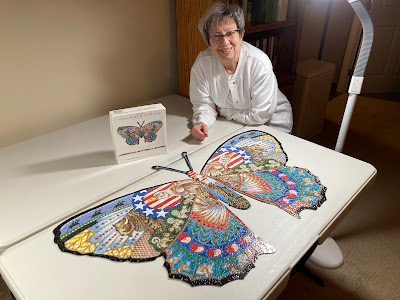
 Mary gets pretty deep in thought when winding her way through the tangles of family history research but likes to retreat occasionally into the mindless activity of putting puzzles together. This one is probably my favorite of those she's completed.


Friday, January 7, 2022

New Year Musings


Bits and pieces of stories come to light but not to the point where I take time to formulate full articles without research.  Sometimes I read things that make me want to dig a little deeper. So it was when I picked up a copy of the High Plains Reader in Fargo the other day and found an article “Tootsie Rolls, The Candy That Saved the Marines.” 

     The setting of the story takes place in Korea during that infamous war fought in the 1950s. Chinese soldiers were pouring over the border during severe winter conditions to attack our military, many of whom were U. S. Marines. Frostbite, equipment failures, frozen C-rations, frozen fuel lines, frozen medical supplies all resulted from as much as -50 degree temperatures during the night. 

     Ammunition to stave off the attackers ran low and a radio man was ordered to order more, including mortar shells. He used the code word for mortar shells which was Tootsie Rolls. On the receiving end the radio operator didn’t have the correct code and took the message at face value. Somehow he rounded up cases of the candy and had it delivered to the embattled defenders. Apparently it didn’t turn out badly since the hungry men gladly ate them for the energy it provided. After thawing the Marines also used them to plug bullet holes in various tanks and radiators where when plugged in they re-froze and formed a temporary fix.

     The lady who wrote the article is associated with the North Dakota VFW Auxiliary. To verify the story, I found much the same article on a United States Marine Corps website. The Korean War doesn’t receive much attention nowadays but if a reader wants a refresher, get a copy of  David Halberstam’s book The Coldest Winter to read a superb one-volume history of the conflict.

*** 


      As settlers and miners started moving westward into those parts of the country known as Indian territory, forts were built to protect them. Like any small town of today they needed supplies to fill their pantry shelves. When the railroad came through, freight cars hauled it, but before that teamsters driving ox teams pulling covered loads furnished the necessities.

     The job was not easy nor very high on the social scale. Who could be tapped to do the work of snapping bullwhips and swearing the beasts forward to a market? Emancipation freed blacks, some of whom took up these jobs. But another group, immigrants who were looked down on, became available, too. They were the Irish who started coming during their potato famine and continued coming to escape from under the harsh rule of the English government. 

     Many of these mule-skinners and ox-drovers who came through our area were indeed Irishmen and some of them stayed, not wanting to go back to persecution. Religious issues were paramount, that is Protestant versus Catholic. From what I know ill-feelings about it still simmer today meaning that it was very deep-seated.

     An interesting catchphrase then came into being - “Beyond the Pale.” England maintained a strong presence in Ireland and found themselves being constantly provoked and attacked by Irishmen who resented them. To protect themselves, the English built a long fence called a pale through which Englishmen dared not travel nor Irishmen dared enter. Today the phrase can still be heard and I think is usually understood as being something happening out of the ordinary.  It’s one of those phrases we can use freely but its original meaning has become lost. 


***

     This cold weather gets old mighty fast. I’ve already started wishing it away. Like Tennyson should’ve said - in the spring a young man’s fancy turns to… baseball?  Sounds good to me.  The magazine editor I work with in Santa Fe, New Mexico is a walking baseball encyclopedia. He came to the craft of writing via being sports desk editor for Texas newspapers and has become a successful award winning Western writer. One of his books titled Camp Ford deals with baseball in a Civil War prison camp of that name. Union prisoners challenge their guards to play games of baseball.


     Because of our association we communicate regularly and his last letter reminded me of spring and baseball and the sound of the bat and the roar of the crowd. He is a Kansas City lover who one time drove to see a game there and missed out on a Nolan Ryan no-hitter back home. I taunted him a bit on that, but he said he’d already seen Ryan pitch several times. 


     I used to go to baseball games under those lights where the big sign on the outfield fence proclaimed Hendrickson Field. I was born in Enderlin at a Mrs. Opheim’s house under the supervision of Dr. Hendrickson, so I’ll claim some attachment. I only wish I would have attended more games and watched those local baseball heroes: Janz, Foss, Utke, … My aging memory denies me more names. While visiting with Fritz Salzwedel at a funeral a few years ago, we talked baseball, especially that year he pitched all wins with no losses. He was modest and wouldn’t take much credit by saying he couldn’t fail with such a strong team behind him. I am left to wonder if anyone has ever taken on the job of compiling a team history. It would be interesting.

Monday, December 27, 2021

We Celebrated!

 We celebrated this Christmas season with all the immediate family able to come at the same time.


Thursday, December 23, 2021

Newspapers

When I went to the barbershop the other day I had to wait a few minutes while the barber finished with a customer. On the counter sat a daily newspaper, The Minneapolis Star Tribune.  It seemed to be waiting for me to pick up and page through since it had been quite awhile since I had held a real daily paper in my hands. I enjoyed turning the pages. This is not to say I don’t read a daily paper since I subscribe to four of them, two in-state and two national. But here’s the rub, they are digital. Holding a paper in hand like the one in the barbershop encourages a slower, deeper concentration of reading experience for me. Digital versions just aren’t quite as comfortable.


Since we have available so much reading material in our home, it’s been very tempting to make some choices and drop one or two. One of the subscriptions considered for dropping was the Bismarck Tribune, but something occurred recently that changed my mind. The Tribune was the subject of a takeover by a company named Alden Global Capital that made a bid to buy Lee Enterprises, which owns them along with about 100 other U.S. newspapers. 


The management of the Lee company did some maneuvering I don’t quite understand, but it succeeded in making themselves undesirable for the outside company to own. This was important because Alden has the reputation of firing staffs down to bare minimum and sucking out profits and assets. As it stands, the Tribune is a good paper and because of their action to keep the wolves away, I decided they are worthy of my support.


Newspapers and other news media hold a strong place in a democracy. They’ve been called the Fourth Estate, the first three being Legislature, Executive, and the Judiciary. Citizens of this country have a right to know what’s going on with the other three which makes it essential for the media to tell us.


A book by Doris Kearns Goodwin - The Bully Pulpit - clears the way for me as a citizen to understand the importance of journalism in relation to governmental affairs. It outlines a transformative period in our history, especially so with the parts covering “The Golden Age of Journalism.”  


The foremost politicians of the period were Theodore Roosevelt and William Howard Taft, but a journalist named S. S. McClure and his staff caused significant change at high levels. McClure employed investigative reporters, namely Ida Tarbell, Ray Baker, and Lincoln Steffens who successfully uncovered the crimes of robber barons, corrupt politicians, and corporate exploiters of our natural resources. Their reporting gave rise to the term “Muckraker Journalism.”


What was Ida Tarbell’s involvement? Her father had been a small independent oil producer who found the rates suddenly and arbitrarily double on shipping his crude oil by rail. John D. Rockefeller was behind it, a move designed to choke competition and set him on his monopolistic ways. The Smithsonian Magazine states it clearly, “Tarbell would redefine investigative journalism with a 19-part series in McClure’s magazine, a masterpiece of journalism and an unrelenting indictment that brought down one of history’s greatest tycoons and effectively broke up Standard Oil’s monopoly.”


Her father’s bankruptcy rankled her and caused Tarbell to say of Standard Oil, “They had never played fair and that ruined their greatness for me.” She got on Rockefeller’s case and her investigative reporting made Americans realize Rockefeller was a man who drove honest men from business. As a result Standard Oil was broken into baby Standards; he was stung by it all, calling Tarbell “that poisonous woman.”


Ray Baker began to notice a growing tension between labor and capitalists, and his work along that line caused McClure to hire him. Baker developed strong empathy with the working man and reported on the strike brought by workers of the Pullman rail car company whose wages had declined while stockholders dividends increased. In another instance he traveled to Colorado and reported on what he said was “corruption & bribery on the part of the corporations & violence on the part of the strikers.” Where other reporters glossed over details, Baker reported accurately.


Lincoln Steffens was one of these original “muckrakers,” and wrote newspaper and magazine exposés that gave journalism a new purpose, a voice in American democracy. He is especially noted for his reports on the workings of corrupt political machines in several major U.S. cities. They inspired reformers in other cities to address the corruption that plagued their city halls.


Other journalists earned their place in what is called the Progressive Movement. Jacob Riis wanted urban reform, Ida B. Wells sought Civil Rights, Florence Kelley fought for rights of working women and children, John Spargo wrote of the horrific working conditions of child laborers. Upton Sinclair has to be mentioned as the author of The Jungle which told of the unsanitary conditions in the meat packing industry.  


The importance of journalism reveals itself when reading the works of the previously mentioned writers who worked during this period. Both presidents that Doris Kearns Goodwin writes of in the book became supporters of the Progressive Movement and much legislation improving working conditions occurred during their terms in office. Changes occurred with domestic policies, promising the average citizen fairness, breaking of trusts, regulation of railroads, and pure food and drugs. As I mentioned earlier, this was a transformative period in the United States brought about because of exposing through the pens of journalists. That’s what I was reminded of when I held the barber’s newspaper in my hands.


RANDOM THOUGHTS - Wednesday, November 18, 2026

Win or lose, be a good sport … Pocket change can’t buy much anymore … Will AI stifle intellectual curiosity since it always has an answer?...