Thursday, October 3, 2024

More Glory Days


Is there a sport where more statistics are gathered and analyzed than in the game of baseball? Take this one for example: The rarest baseball feat was posted when Fernando Tatis, Sr., a playerfor the St. Louis Cardinals hit two grand slam homers in the same inning in 1999 against the L. A. Dodgers. A number of players have hit two grand slams in the same game but never the same inning.


Baseball has inspired several songs such as John Fogerty’s “Centerfield.” Fogerty wrote and sings it. As a young California kid where no major league teams had yet located, he dreamed of being a centerfielder. After all, his hero San Francisco native Joe DiMaggio played centerfield for the Yankees. He said he also found inspiration from his frustration at watching a favorite team losing on TV and imagining himself a rookie on the bench jumping up and shouting, “Put me in coach, put me in!” The song is such a baseball standard that another statistic lists when Fogerty in 2010 became the first and only musician honored by baseball’s hall of fame.


Turning our attention to the local baseball scene we find some information about Cy Pieh at pinstripealley.com, a New York Yankee history site. Two things about him caught people’s attention. One was his natural talent. The other was the odd way he acted which caused him to suffer the butt of jokes. His frustrated wife told him to “Stop making a fool of yourself, everybody thinks I married a dunce.” Pieh is buried in the Enderlin cemetery.


Lynn “Line Drive” Nelson signed to play baseball with the Fargo-Moorhead Twins independent team in 1925. Upon arriving a boxer known as the Fargo Express, Billy Petrolle, spotted him and talked him into training for the ring, too. Lynn’s manager would not approve of his wish to box.


They agreed on a solution where Nelson would don a mask and be billed simply as the Masked Marvel. Middleweight Lynn Nelson recorded 21 early knockouts in 21 professional bouts. After a standout season in 1925 with the F-M Twins, Nelson caught the attention of a scout from the Kansas City Blues of the American Association. During his pro career, he tallied a record of 33 wins and 42 losses with 29 complete games, two shutouts, and 255 strikeouts.


Terry Bohn’s research and writing about amateur baseball in North Dakota deserves a closer look. I ordered from Amazon two books he authored. I’ll borrow from, especially “Lots More Fun That Way: The First 30 Years of Amateur Baseball in North Dakota.” He expands beyond the thirty year mark a bit when he includes some late as 2013 accomplishments.


He liberally sprinkles Enderlin teams and players throughout his narrative. He tells us Johnny Janz threw a perfect game against Tuttle in the quarter-final of the 1955 state tournament. The team’s thirteen-year-old pitcher named Ray Henkel beat Cooperstown in 1932, but doesn’t say if  he pitched the whole fourteen-inning game. 


Dr. Hendrickson died in 1948 and Pete Redmond guided the Indies to success.The reason for the team’s success throughout the years has been analyzed by many, but the fact that resources were gathered to hire coaches plays strongly. For instance, standout player/coaches

like Johnny Janz, Owen Wallace, and Pete Redmond made for a positive influence on young players.  


Another reason for success recognizes the strong core of good players that stayed together. Adding to these three are John Utke, Wes Peterson, John Foss, Oakley Larson, and Ralph Graalum. The third reason Bohn states for success includes the field lights that permitted long days of play.


Bohn scoured various sources to discover that Janz in 1955 and Jerry Jerdee in 1956 pitched state tournament no-hitters. John Foss in 1955 hit two home runs in one tournament. A dozen team members have been inducted into the North Dakota Sports Hall of Fame in the amateur baseball section: Redmond, Utke, Janz, Wallace, Wes Peterson, Larson, Foss, Abbie Peterson, Haskins, Halverson, Adair, and Bratland.


A section in Bohn’s book includes other information that proved educational for me such as in one chapter “The Influence of McLeod.” The familiar name of Joe Milton enters the picture for

being a strong promoter of the sport and leading that team to the state tournament in 1948. Dale Sveum played in the major leagues for twelve seasons. John Olerud was an American League batting champion and a two-time all star. Two good pitchers, Gerald Ankerfelt and Clayton Johnson, received a thumbs-up mention.


I taught at the Wahpeton Indian School for a long spell where the name Woody Keeble is held in high regard. This wartime hero won many commendation medals including the Medal of Honor

posthumously for his bravery in the Korean War. He used his strong and accurate pitching arm to hurl grenades with deadly accuracy. He had been recruited by the Chicago White Sox in 1941, but entered the Army when World War II broke out.


One other person whom I did work beside for many years in Wahpeton was Don Berg who receives mention in the book for his athleticism which Berg himself never spoke of. I only knew him as a middleweight golden glove boxer, but there was more. In the 1949 state baseball tournament Hettinger wanted to add Berg from the Ellendale team to their roster, but he ran intoa conflict. College classes had started in Ellendale where he was a star halfback on the football team.


Letters to the editor about the sporting scene in and around the area would be welcomed. More articles about it will appear as material presents itself. And as John Fogerty’s “Centerfield” opened this article, we’ll close with Bruce Springsteen singing “Glory days, well, they’ll pass you by…”

Glory Days


“His line drive came right at me. When I reached for it the tip of my glove deflected it enough to rise and sail over the fence. Good thing I didn’t lay a hand on that ball or it would’ve torn my

hand off.” So said an acquaintance of mine who was playing first base for the Blue Ribbon Allstars when Enderlin Indies player John Foss came to bat. I’d seen how hard Foss could hit and

knew my friend was not exaggerating.


Baseball memories! For some people they’re the best. One can dive into the game’s rich history or attend games for enjoyable entertainment. Now it’s spring and my thoughts have naturally

turned to baseball. Like many others I search for diversion from the sad state of political and social affairs encountered in our daily news feed.


I claim a flimsy relationship to Hendrickson Field in Enderlin because, after all, Dr. Hendrickson delivered me at the Opheim house one cold February morning in 1942. What better reason to talk

about the Indies and other teams in the area?


Organized baseball experienced difficulties early in statehood. For the most part farmers worked long hours six days each week. Sundays offered their only day for recreational activities, but the

farm boys found a roadblock. North Dakota’s constitution banned sports that day, terming it “sabbath breaking.” Even earlier, the move to ban it gained traction.


 Here is what the editor of the Sheldon Progress wrote in 1885: “Some of our young gents, not having the fear of their creator before their eyes. indulged in a match game of baseball last Sunday. Don’t do so any more, boys.”


Sixteen years later, a later editor of the same paper, wrote this admonition: “Some of the Sheldon young gentlemen who think more of worldly affairs than they do of spiritual things so far forgot

themselves as to mix-up with the hobo crowd Sunday in a ball game. Playing ball on Sunday is shameful, sinful, and unnecessary and should not be allowed.”


He went on to say he was “reading his Bible but afterwards learned the score stood 5 for Wiper and 4 for Bill Sorenson.” He must have felt obliged to criticize this Sunday game, (but wink, wink) reported the score for interested readers. Finally, in 1917, the yoke was eased when legislation removed the Sunday ban.


A player from this area named Cy Pieh, “Cy” because his pitch seemed to come out of a cyclone, earned some national prominence. One noteworthy event came in his career while playing for the Yankees in 1915. Babe Ruth, the starting pitcher for the Red Sox, hadn’t established himself as a hitter yet, but this day he hit the first of his career 714 homeruns on a pitch Jack Warhop threw in

the third inning. Cy Pieh, a spitballer, came in as a reliever in the ninth inning, pitched five scoreless innings, and received credit for the victory. Pitching spitballs wasn’t outlawed until1920. For reasons unknown here, seventeen pitchers were grandfathered in and permitted to continue using “the wet one” throughout the rest of their pitching days.


Lynn Nelson was born at Sheldon in 1905 and played major league baseball for all or part of seven seasons with the Chicago Cubs, the Philadelphia Athletics, and the Detroit Tigers, from 1930 to 1940. A pitcher, his win-loss record was 33-42 with 255 strikeouts and an earned run average of 5.25. Nelson’s nickname, “Line Drive,” seems to have come from either of two reasons: he batted well, but he gave up lots of homeruns. 


Before concentrating on baseball, he exhibited some prowess as a middleweight boxer and took pointers from his friend Charley Retzlaff, the Leonard, ND, heavyweight who had fought Joe Louis.

The Society for American Baseball Research wrote about the time Nelson was asked about the origin of his nickname. He said, “I would like to say it is because I hit so many line drives, but

the fact of it is that they tacked that name on me several years ago when I was a member of the Chicago Cubs. The opposing batters had a habit, most annoying to me, of hitting liners past my ears, and one of the baseball writers decided I should have a nickname along those lines.” 


As a pitcher he was a good hitter with an overall batting average of .281. Terry Bohn’s work of collecting and publishing facts and anecdotes about amateur baseball in the state gives as good a picture of the sport that I know of. In one book, “Lots More Fun That Way,”

he alluded to a feature article in the Jamestown Sun that tried to explain the continued success of the Indies. The number one reason given, “A core group of very good players stayed together for many years.” Several of those team members have been named to the North Dakota Amateur Baseball of Fame. 


A second reason given was the installation of lights in 1948. Several pages of baseball history written by Carole Tosseth were included in the Enderlin centennial book. The story includes a picture showing the installation of those lights which brings back a memory. My dad liked watching games and took me along. The caption lists the year of 1948 when the towers were raised. Then in August, 1949, a big dedication ceremony was held, and if memory serves, I was there.


It’s necessary to draw heavily from other people’s experiences and collections of memories for baseball writing. Various centennial books, Terry Bohn’s books, the Sheldon Progress, internet sources, and first hand accounts like the one in the first paragraph all add to this writer’s meager store of information. Do you have any to share? I would be willing to collect them and share them with the audience that reads this paper. Email me at lynn.bueling@gmail.com. 


Anecdotes make for interesting reading. Stories from any or all teams and communities are welcome and contributors’ names won’t be used without permission. We know other towns in the surrounding area fielded teams, too. Through the years, Sheldon made a strong showing with some great players. McLeod wrote with pride of their baseball history in their centennial book in 1986. Alice included pictures of teams in their 1975 jubileebook. In fact, the makeup of the area Blue Ribbon League from 1950-1968 includes the nearby

towns of Alice, Sheldon, Buffalo, Chaffee, Fingal, Nome, Oriska, Tower City, and more.

Monday, September 30, 2024

RANDOM THOUGHTS - Monday, September 30, 2024

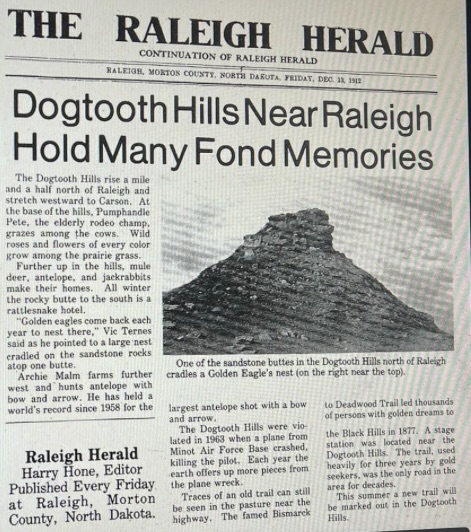
Big crowd at Fort Ransom on Saturday arts and crafts show … Many classic cars showed up for their show, too … We couldn’t get to top of Standing Rock hill, road impassible … Watch Clay Jenkinson (Listening to America) at Maple River near Alice where Steinbeck claims to have camped next door to a Shakesperean actor … So much beautiful farm land being bought by developers to add to their wealth … You’ve a right to your own opinion but not to your own facts … Vikings won, barely … Great dinner today at St. Anthony’s … Alaskans get an annual payout from mineral sales, why can’t we? … These hills were nearby the farm where Mary grew up. They looked like teeth on a jawbone.


Monday, September 23, 2024

Random Thoughts, Monday, Sept 23, 2024

 Still recovering from a four-day weekend … Thursday’s trip to Mandan to attend a funeral at Veteran’s Cemetery … Friday’s trip to Enderlin for business and watch ribbon cutting for elevator into their museum … Saturday’s attendance at an all-day workshop family history wor
kshop featuring Scandinavia … Sunday’s birthday party for our now ten-year old granddaughter … Purchased a book in Enderlin titled “Passing Through” about an area family … Will need a nap this afternoon … Usually always need a nap … Need to edit a new column and then start writing another … Bison and Vikings are looking good … Became acquainted with two Foss sisters in Enderlin who liked my stories about Enderlin Indies and their brother John ( picked up baseballs in their nearby lawn hit from ballpark) … Anyone want to suggest a story to write for Enderlin Independent paper since I am always looking … Another puzzle finished by Mary ...

Friday, September 20, 2024

Days of Prohibition

Vocabulary terms spring up around some activities. For example the term “bite the bullet” originated in the days before anesthesia when a wounded soldier was told to bite the bullet placed in his teeth to stand the pain of the surgeon’s knife. “Cash on the barrelhead” came from those days of sparse furnishings in frontier barrooms when they upended barrels to use for tables and drinks were paid for with cash on the barrelhead.


Because North Dakota banned  sales of liquor, a simple solution gave birth to another expression. Thirsty men could board the N. P. train at Sheldon, ride to Fargo, and catch a ride  in the waiting shuttle wagons. Their destination was wide-open Moorhead where they could drink freely in one of   many saloons. Occasionally, a drunk, on the return trip sometimes “fell off the wagon.” Of course, today we might say that when someone starts drinking alcohol again after refraining for a period.


The prohibition clause in our state constitution had caused North Dakota’s saloons to lock their doors on July 1, 1890. Creative scrambling started taking place to supply drinkers with product. Druggists were allowed to dispense alcoholic tonics for health reasons; one commentator observed this made for a very healthy population. Moorhead entrepreneurs shipped beer into the state by stashing beer bottles into sugar barrels. And there was always the home-brewed variety.


Dramatic action like prohibition required some strong leadership to attain. One of those leaders was a lady named Elizabeth Preston Anderson. She was asked what caused her to be so passionate about it. While employed as a teacher in Page, North Dakota she lived in a hotel room. One morning  she looked out the alley facing window and saw a young man sprawled out in the garbage with flies crawling on his face and into his open mouth. She reacted by deciding then and there to fight against liquor’s availability. She said, “I looked at my boys in the school room that morning, bright, eager youngsters, and wondered who among them would be victims of this licensed and protected monster.”


She joined the Women’s Christian Temperance Union and served as president for 40 years. Not afraid to travel around the state the crusader announced that the annual state convention would be held in Lisbon on September 13-17, 1901.


A dozen or so years earlier her hand could be found in drafting the state constitution in 1889. She wanted prohibition included in it, but other committee members were a bit leary thinking that item could cause the whole document to be defeated by voters. So a separate prohibition clause accompanied the constitution. It barely passed with 1,159 votes while the constitution’s approval itself fared well, 27,441 to 8,107.


The numbers somewhat reflect an east-west split with the Scandinavians in the east  opposing liquor sales and the Germans living farther west liking their spirits. They brought their heritage of celebrating with alcohol to this new country.


In my humble opinion, this is where it gets interesting. In 1909 a new state attorney general, Andrew Miller, took office and set out to make a name for himself. Possibly influenced by the WCTU, he had declared he would clean up “bad spots,” which meant he would move in a short time against the sheriffs of counties where violations of the law were most flagrant.


The state’s attorney and the sheriff of Grant County drove to Carson one day in 1909 to check out the rumor of illegal liquor sales in the barbershop. Upon inspection, they decided everything looked innocent enough. But wait, is that a trapdoor the barber is standing on? They lifted it and found a cellar concealing more than a thousand bottles of whiskey. The bottles were emptied on the prairie, and the sheriff promised more raids would follow.


My dad told a  story of prohibition days that featured his grandpa, my Great-grandpa Sam Menge. I have no date, but given the context I believe it was  during A. G. Andrew Miller’s term in office, 1909-1914. One day the sheriff called saying he was coming to his farm to check on rumors of a still. Let’s pause and think about it. The sheriff was more than likely one of those pressured by Miller to clean up “bad spots.” Therefore he would have to comply, but people like Sam Menge were constituents of the sheriff and had probably voted for him. Caught between  the law and a friend, he fulfilled his obligation with a warning ahead of his visit.


Yes, Sam had a still! This German from Russia immigrant intended to make his own liquor when he couldn’t buy it. Given the sheriff’s warning, he simply dismantled the still and looked at the cupola on top of the barn. That’s where he stashed it, piece by piece. The sheriff did call on him and conduct a superficial inspection. He probably stayed to visit awhile, maybe even have a cup of coffee, and then went on his way. I never heard how long Sam waited before bringing the apparatus down to reassemble it. Many details of the incident have disappeared into the mist of the past. It illustrates one of the difficulties of enforcing prohibition.


The federal government on January 19, 1919 decided everyone should stop using alcohol with the 18th Amendment to the constitution. The period of Bonnie and Clyde, Al Capone, and other lawbreakers arose and operated until the repeal of the 18th Amendment by the 21st Amendment in December of 1933. The prohibition clause in North Dakota’s constitution of 1889 was tossed out with its repeal on November 8, 1932.

Thursday, September 12, 2024

Train of Thought


With only a casual look, one can find a lot of interesting material about the railroads in the area. For instance, the Northern Pacific reached Sheldon on November 4, 1882 whereas the Soo Line arrived in Enderlin sometime in the fall of 1891. 


I’ve read that it takes about 3200 wooden ties per each mile of railroad track and that a mature oak tree yields four ties, therefore a little over 800 trees must fall to the axe for each mile of rails. Other trees like the softer cottonwood or pine could be used, too. They treated those ties with a solution of zinc chloride to prevent wood decay. Not just ties needed that wood. Consider the huge bridges like the original and large Gassman Coulee Bridge west of Minot, the towns and farmsteads built as the rails stretched onward, and the wood used for fuel and heating. 


 It boggles my mind to think how we have any forests left at all, but conservation measures must have the harvest under control since we never hear much about a shortage. There was a time though when business tycoons gave no thought to the idea of forest conservation. Only when the U.S. Forest Service came into being was it slowly brought under control.


It would have been interesting to soar like an eagle and watch crews setting the rails. One writer watched the transcontinental railroad’s construction and observed, “Five men to the 500-pound rail, 28 or 30 spikes to the rail, three blows to the spike, two pairs of rails to the minute, 400 rails to the mile…” 


Track laying was about the last step in the process. First the surveyors walked across the land and sized up the terrain looking for the best route to follow. When it was chosen, graders came in to form the roadbed. Cuts needed to be made to lower hilltops while fills leveled depressions. Mechanized machines were not yet available. Shovels and picks and wheelbarrows moved the soil where they wanted it. 


Population in the countryside was sparse. Not much manpower came forward to work on construction. Therefore work crews were imported. Greeks, Italians, Chinese, Irish, and others came to work, send money home, and return home when the work was through. Men in the Owego settlement worked building the bridge across the Red River and weren’t present during one of the Indian scares. The women fled to safety elsewhere.


The suspicions aroused when a surveyor noticed an erratic compass reading probably caused the gold fever in the Lisbon area. The surveyor returned the next year to see just what caused it. When word spread about his activity with a shovel and crucible, the rush was on.


Sometimes the construction crews met resistance. Indians made their resentment known in the early days. While they probably didn’t pose much threat in this area, battles did occur. The Soo Line crew encountered some real opposition at Hankinson, and it wasn’t Indians. It seems that whenever rail lines crossed, the first company to reach that point earned the right-of-way to pass through it in the future without stopping.  


As the Soo Line crew and the Great Northern crew drew near to each other, they realized either side could cross first. The Soo crew was a few hours ahead so the Great Northern resorted to the dirty trick of placing roadblocks in the Soo’s path to slow them down. Then they armed themselves with firearms and extra manpower to emphasize their stance, but when the sun rose next morning they found they had been outplayed. The Soo crew had worked all night and  crossed the coveted point first. The Great Northern acknowledged their loss and work continued.


The rail lines connected North Dakota wheat fields to the mills in Minneapolis, but it also connected cattlemen to their markets. Long trains of cattle cars rolled down the Soo Line filled with western beef. Because of the time and distance involved, Enderlin provided a midway stopover for feeding and watering. A nice picture of those large stockyards can be found in the centennial book. An article in the Independent relates how workmen sometimes had to work all night to get them fed, watered and reloaded.


The ranchers had the privilege of riding along with their cattle if they wished. My father-in-law who ranched west of the Missouri River told of doing just that when he and neighboring ranchers pooled together to ship them to Sioux City. His wife packed lunch for him, but  the accompanying ranchers never seemed to have any. One can guess how closely they watched each bite taken by my father-in-law. My wife and her siblings always looked forward to his return and the sack of candy he usually brought home for them.


Construction crews required hearty meals. Herds of cattle accompanied the work crews and butchers kept busy supplying fresh meat to the cooks. This was nothing new since cattle herds often accompanied large groups of men on the move. Both Sibley and Custer trailed cattle right along with their expeditions.


Railroad companies have adapted to economic demands. Long trains haul freight in bulk quantities. Local grain companies benefit from their modernization. Easy to load and unload unit trains now service elevators built to accommodate them. A new facility has been built in Sheldon with a siding track for trains to sidle up beside. It provides a large capacity storage area for grain handling in the most efficient manner.


The country has benefitted from railroads in different ways. It certainly aided in settlement of the West. Emigrant cars brought families, livestock, and machinery to their new farms;  employment opportunities arose, on the railroad and with new businesses that started up; new towns appeared to provide markets; and they generally tied the country together. 


Labor Day Thoughts


Our annual celebration of Labor Day just passed, and like most holidays it was just another day with no mail delivery. Was there any celebration? It has no connection to religion, or veterans, or the passage of any declaration, so what’s the deal? The day seems to mark an unofficial end of summer. The school year begins, lake cabins are closed up, and a variety of high school, college, and professional sports entertain their followers. Some retailers claim it is one of the largest sale dates of the year, second only to the Christmas season’s Black Friday. Unfortunately with the passage of time, we’ve forgotten the reason for commemorating it.


In the latter part of the 19th century workers began demanding better conditions. 

They adopted the slogan “Eight hours for work, eight hours for rest, eight hours for what we will!” The roots of Labor Day grew out of violent clashes between labor and police during the Haymarket Riot in 1886 when thousands of workers in Chicago took to the streets to demand an eight-hour workday. The term Haymarket Riot has become one of those buzzword phrases that loses meaning after the passage of time. I had to look it up.


The Haymarket of Chicago consists of a large space holding a public scale where farmers once brought their hay for weighing and selling . Because it was an open area, it could accommodate large gatherings of people, and on May 3, 1886 did just that. The time had arrived when a nationwide labor upheaval of workers began protesting work conditions. A general strike was called for in the city and tens of thousands of them walked out and began marching. In this market place, historians tell us the roots of the labor movement began for better pay, safer working conditions, and fewer working hours.


A large cross-section of workers participated this day, some were thought to possess ulterior motives for  doing so. At the McCormick Reaper plant striking workers began fighting with non-union “scabs.” Police arrived, wielded their clubs, and shot pistols into the crowd, wounding several and killing two. The next day, May 4, saw smaller crowds, but die-hard strikers and some anarchists gathered again. The last speaker spoke from a hay wagon and spewed fiery language which inflamed many of them.


At this point the police had heard enough and started advancing on the crowd. Any chance for a peaceful conclusion to the day ended when someone in the crowd threw a dynamite stick into the knot of policemen where it exploded and caused death and injury. They panicked and started shooting into the strikers to cause a chaotic scene. Sixty officers lay wounded and seven died. Several dozen civilians were injured and at least four were killed.


Other issues issues arose in addition to hours, pay, and safety after people settled down and analyzed the situation: freedom of speech, freedom of the press, the right to free assembly, the right to a fair trial by a jury of peers and the right of workers to organize and negotiate for things like the eight-hour day.


Just like today, immigrants with their loyalties in question received a good deal of the blame for the violence. People elsewhere in the world who experienced many of the same conditions closely watched events unfold here. Many countries recognize May 1 as Labor Day; some call it May Day, some call it International Workers’ Day. In the U. S. and Canada we celebrate it on the first Monday of September. Separate monuments in Chicago honoring both the policemen and the protesters can be found. As for its official status, Grover signed the law on June 28, 1894 making the first Monday of each September a national holiday.


September 11

  Twenty-five years ago the Twin Towers in New York City fell … I am saddened by the deaths of Wendell Berry, Dolly Parton, even Gloria Stei...