Monday, April 11, 2022

Wolves Captured

 Posted in "Sheldon - Remembering Our Past"

May, 1911 Headline in the Sheldon Progress: Carl Bjugstad captures a large den of young wolves on the Sheyenne last week. 


     That digging out wolves is a profitable business was practically demonstrated last Friday when Carl Bjugstad captured eight of the whelps. Mr. Bjugstad discovered the den along the banks of the Sheyenne and watched his chance to catch them in their den. He says that this was one of the largest dens he has ever discovered and over a half day was spent in capturing them. The whelps were about half grown and put up quite a lively scrap. The county and state each pay a bounty and a nice little sum was realized.


     (Readers today will recognize Carl Bjugstad as the father of Charles and Marty.)


Thursday, April 7, 2022

Idioms

 Our English language is cluttered with sayings or idioms that are repeated enough times to feel comfortable in their usage. Consider someone who “knows the ropes.” We use it to describe people who know their way around a job or situation. Its original use goes back to the days when big ships sported huge sheets of sails to catch the wind that propelled them forward. 


A recent “CBS Sunday Morning” program featured a bit about sailing ships. A sailor pointed to all the ropes, 200 different ropes, each having a name, that attach to the sails. Each sailor is expected to learn the name of each, the different knots used in securing them, plus however else they are used. Therefore a competent sailor “knows the ropes.”


We can have some fun by stringing a few idioms together to make somewhat meaningful sentences such as these. I don’t know the original usage that gave birth to them but recognize them for being idiomatic. How about “He spilled the beans when someone threw a monkey wrench into his plans by letting the cat out of the bag, so he stopped beating around the bush,” or “He thought he should keep an ear to the ground instead of always finding himself up a creek without a paddle,” and one more, “After he scraped the bottom of the barrel, he drew the line, took it all with a grain of salt, buried the hatchet, went cold turkey, and then with a big yawn hit the sack.” Readers will agree these examples are a bit extreme.


Some people are quite adept at mixing idiomatic expressions into their regular speech. My college major was English and I know correct English usage, but I’ve always used idioms, sometimes on purpose, but often times without realizing it. Try to talk without using them. Then you realize how ingrained idioms have become. At any rate, my English usage has become a bit rusty (Oops, did I say “rusty?”).


Consider that first idiom - “knowing the ropes” -  in  context by attaching it to a historical character.  I read a lot of history and have just purchased a book called THE TRIALS OF HARRY S. TRUMAN. Truman came to Washington as a U. S. senator from Missouri, served ten years in that position while finding it agreeable and enjoyable, but events occurred to place him in the ranks of major players in world history.


We know he was the successor to Franklin D. Roosevelt as president, but how did he find himself in that position, a position he never sought, a position where he did not “know the ropes.” When FDR decided to run for a 4th term, he chose a new vice president. Two choices stood as front-runners, Henry Wallace and James F. Byrnes, but political problems with each man made him look at other choices. He selected Truman for reasons of being the safest choice.


After the election and inauguration, FDR died after three months into his 4th term to leave the mostly uninitiated vice president to take over. Whether it was his progressing illness, indifference, or a belief he would live forever, FDR never brought Truman into his circle. In fact they met only one time. Then he died, and a stunned Truman took the oath to serve as president. He had to “learn the ropes” immediately since the United States was in the last stages of a great world war. Could Truman rise above the fray? The historian David McCullough wrote in his book TRUMAN how three American generals - Eisenhower, Bradley, and Patton - sat sadly speculating on his probable failure, a mood prevalent in the country.


Truman was the only president who never attended college, but not because he wasn’t intelligent. He was intelligent and to bolster his world view he was a voluminous reader of history. He quickly learned the requirements of his position and rose in the ranks of presidents to the “near great” level as determined by historians.


As the war in Europe finally ground down, the Japanese matter awaited its conclusion. Rather than risk deaths of U. S. servicemen in an invasion, he approved the use of atomic bombs which brought the Japanese to terms. 


Truman’s popularity began rising and his confidence grew. After the war’s end he voiced the Truman Doctrine to give political, military, and economic assistance to European countries. In 1948, he promoted the Marshall Plan to generate a European resurgence of industrialization and steered extensive investment into the region.


When the three majors Allied powers - U.S., Russia, and Great Britain - divided Germany, 

Berlin became a focal point after Russia blockaded any supplies going into that city. In answer, Truman said we were in Berlin by terms of the agreement and Russia had no right to change it. The historic Berlin Airlift flew in that city’s requirements for a year over the heads of the Russians until an official corridor provided access.


Truman promoted and successfully saw the United States as a founding member of the North American Treaty Organization. We recognize it easily by its familiar acronym NATO. It is this defensive treaty we hear much of today in Ukraine.


Some readers might think little of Truman and his time in office. I would argue much of what he did was good and is a sterling example of leaving the office of the presidency “knowing the ropes.” He had many skeptics, but many converts. Here is what Winston Churchill said of him: “I misjudged you badly. Since that time, you more than any other man, have saved Western civilization.”

RED FAMINE

      I’ve had a look at the book that comes with some recent promotion - Red Famine: Stalin’s War on Ukraine by Anne Applebaum. Copyrighted five years ago, the message it carries applies to today’s war in that country. A few of her statements hit hard.

     Ukrainians’ farm and garden produce along with their animals had been taken from them and a killing famine called Holodomor resulted in 1931-’33. Up to five million of them died. Applebaum states some wrote directly to the Kremlin, asking for an explanation. One of them said “Honourable Comrade Stalin, is there a Soviet government law stating that villagers should go hungry? Because we, collective farm workers, have not had a slice of bread in our farm since January…”


     And in another letter, “Every day, ten to twenty families die from famine in the villages, children run off and railway stations are overflowing with fleeing villagers. There are no horses or livestock left in the countryside…”


     One more, “The famine and its legacy play an enormous role in contemporary Russian and Ukrainian arguments about their identity, their relationship and their shared Soviet experience.”


     Applebaum comes with credentials and experience to produce a relevant book such as this. Among others things, she is a Pulitzer Prize winning historian.


Wednesday, April 6, 2022

Tidbit from the Early Days

from "Sheldon - Remembering Our Past"

 I like reading about our town of Sheldon and its beginnings. The early editions of the local newspaper contain the most readily available information. Following are a few tidbits gleaned from the pages of the Sheldon Enterprise which later became the Sheldon Progress.


1881 - Frank Connelly stated when a lumberyard was started at Buffalo, he hauled the first load of lumber that started the building of Sheldon. - In another article he told of a man who’d come through the area in November and slept under his wagon for shelter. He had long hair and when he woke in the morning it was frozen to the ground which his companions had to cut through with their knives to free him.


1885 - The freight business of the Fargo & Southwestern is rapidly on the increase. Twenty cars of freight passed through west yesterday…. There is a scheme on foot to connect Sheldon and Fargo by telephone… Prairie schooners are passing westward almost every day. Train loads of emigrants and emigrant movables continue to pass west…. City marshal Sanborn has given some of our hilariously inclined farmer citizens a little wholesome advice lately, in consequence of which they crawled into their wagons and made tracks for home.


The WPA files contain first person information about the early days. A Mr. Frank Trumble stated during the winters of 1882-83 there were a few buffaloes out in the sand hills, but most of them had been driven farther west around Bismarck. The prairie around here was covered with buffalo bones, and the people would pick them up and sell them or use them for fuel.


There was a traveling chapel on the Northern Pacific Railroad. It was under the auspices of the Episcopalian Church and held an altar and seating and would be sidetracked in small towns and villages. There it would remain for a weekend or a week or two. Services would be held for the people of the community who otherewise never had any sort of public worship. Mr. Underwood recalls seeing this car in Sheldon twice in the summer of ’83.


1886 - The timbers for the new bridge across the Maple River in Highland Township came last week and were unloaded Saturday and Monday. The lumber came some time ago and is already on the ground…. Chauncey Durgin is putting in an ice box in the White Elephant Saloon.


Business in Mandan

We had business in Mandan yesterday, lunch with Mary’s family, and a visit at the Heritage Center where I  got reacquainted with some of the folks I’d worked with while volunteering there. The pictures included here feature a man who dressed the part in the museum and loved showing off the old car in the lobby. He knew quite a bit about it and said his wife’s grandfather had refurbished it after finding it in a rundown condition.


On the drive home, I saw something I’ve never seen. Coal trains are common on the rail line that parallels I-94, but my wife and I both noticed something very different about this one - it was much longer than usual, twice its usual length. As we drove along we came upon three engines in the middle that seemed to pull and push at the same time. Then as we drove to its head there were two engines powering along. What was the benefit of two trains being hooked together? One engineer in control? The long snake was probably meant to be broken up somewhere ahead, but still I wonder. And waiting at a crossing would’ve taken twice as long.


Sunday, April 3, 2022

At the Meet


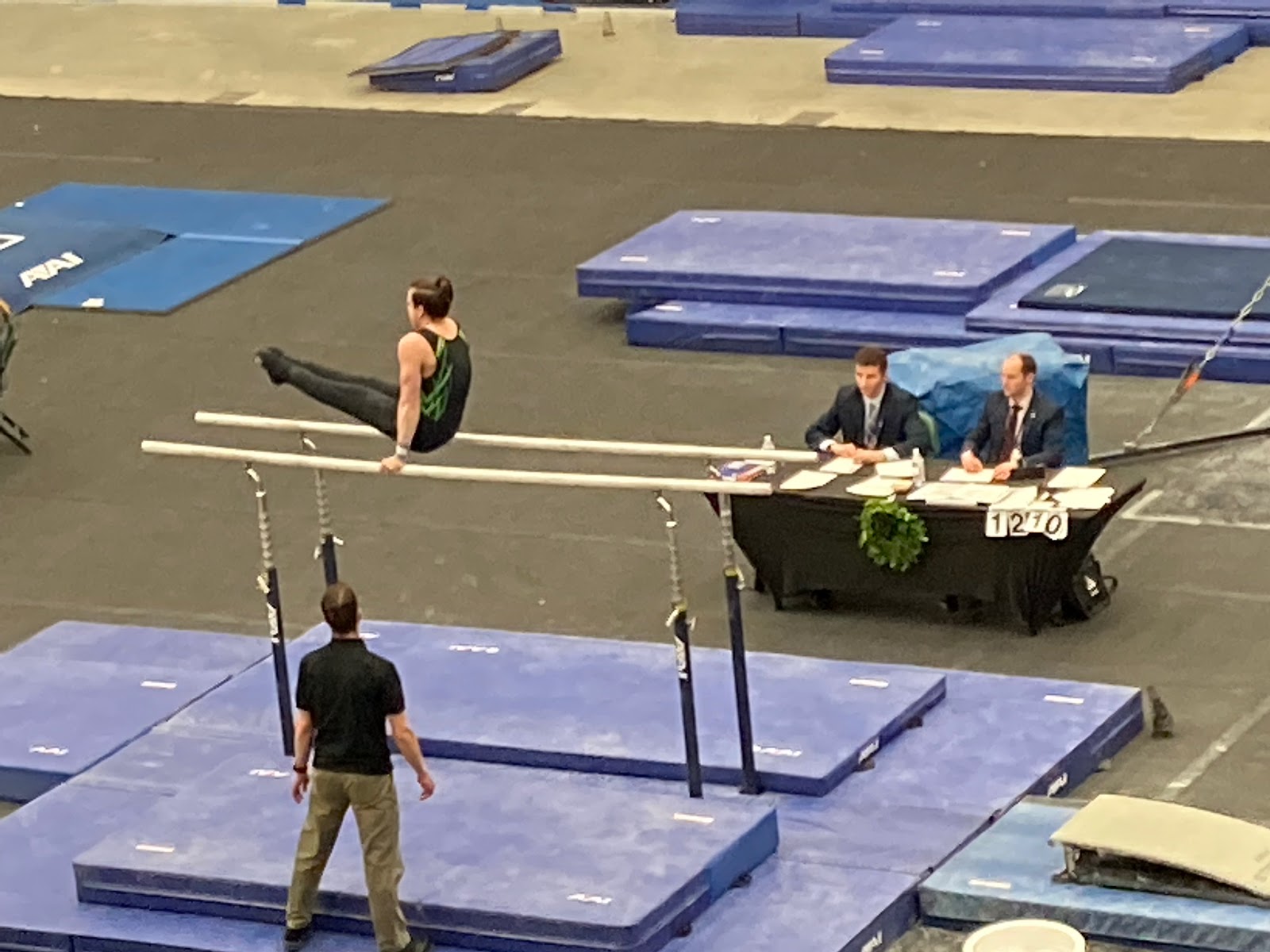
Our family gathered to watch Lucas compete in a regional gymnastics meet at the SHAC on the NDSU campus in Fargo. His working hard at the sport makes it look easy, but there’s been sweat and injuries along the way. His performance yesterday (Apr 2, 2022) earned him a spot at the
  nationals in Reno, NV.


The pictures show all four of the grandkids, and all are doing well for themselves.


Friday, April 1, 2022

Books in a Box

    When my wife said I have too many books lying around. I responded by saying they all fit in a box, honey. There you go again, she said, when are you going to stop calling our house a box?

     This didn’t really happen, I just like the joke. She has quite a collection herself. Between hers and mine they do fit in a “box.” Sorting them for donation elsewhere is an ongoing task, but numbers don’t decrease because more keep coming in. Barnes and Noble gets a fair share of our business, and we also find cheaply priced used books in various places. The libraries in Fargo and Moorhead have kept me well supplied  with many $1-2 books, and when they get overstocked with a used inventory, like now, they were charging only .50 apiece. 


     I recently bought, at full price from B&N, a new book called THE TRIALS OF HARRY S. TRUMAN. Its subtitle calls it The Extraordinary Presidency of an Ordinary Man, 1945-1953. He was president at that stage of my life when I started remembering. An unlikely president, FDR took him as his vice president for political reasons, and thought he couldn’t harm anything. FDR must have thought he’d live forever, but then he up and died leaving Truman to succeed him. 


     People didn’t expect much from Truman, but he went on to earn his “Give ‘em hell, Harry” nickname. His time was marked with dropping an atomic bomb on Japan, firing General MacArthur for insubordination, instituting the Berlin airlift, integrating the military, and more. He was just a common man from humble beginnings who rose to great heights. I have read David McCullough’s excellent history of Truman, but I want to read another historian writing of his life. The book promises incidents and facts of his presidency that I don’t know yet.


     Here are a few of them in the 50 cent category. DARWIN: PORTRAIT OF A GENIUS caught my eye. We still talk about evolution: is it legitimate or did God make it all in a week? Everyone has decided for themselves.  The author points to Darwin’s ancestors, many of whom possessed superior intellect; therefore, he inherited some genetic predisposition. Given only a month to prepare for a voyage of discovery expected to be two years in length, it lasted instead five years. Notes, specimens, new sites all steered him to the conclusions he made when he returned home.


     ALEXANDER HAMILTON: A BIOGRAPHY reminds me he was a founding father of the United States, fought in the American Revolutionary War, helped draft the Constitution, served as the first secretary of the treasury, and was the founder and chief architect of the American federal banking system. He died in a duel with Aaron Burr that his manhood seemed to dictate he had to take part in even though he was opposed to dueling. Up til that time, Hamilton had been a major player in the politics of the country, but as was noted, that event also killed Burr politically.     


     CATHERINE THE GREAT is a name well known in our household because of our membership in the Germans from Russia Association. It is she who invited our relatives in Germany to resettle in Russia and bring a bounty forth from the rich soil. The serfs prevalent among the Russian population were too primitive. She, born a German, knew Russia was backward and that the population needed to be infused with some progressive ideas.


     The last of the 50 centers to add here is A REPORTER’S LIFE: WALTER CRONKITE. The book outlines pretty much what you’d expect from this man who spent his career working with news of the day, but when he came to one point, I sat up to take notice. He attended high school in Houston, Texas where he’d started to notice racial injustice. The father of his girlfriend noted Walter had been making some deliveries for a drugstore in town. As they visited, the father remarked “Nigger boys deliver for them, don’t they?” He went on to add he didn’t know Walter’s parents but was surprised they would let him do that.


     It was a prevalent attitude among his crowd of friends of whom he remarked: “In those high school years I accepted the fact that my friends were inheritors of a culture built on slavery as an economic reality.” Upon reading that I immediately thought of this critical race theory that so much has been made of lately.


     So much to read, so little time! Then there is the book my wife thinks I should read, one I have no objection in doing: A LONG PETAL OF THE SEA by Isabel Allende. Several volumes by this author set on my wife’s shelves.  This one deals with the 1930s Spain that struggled with two forces of government: fascism and communism. It developed into a civil war where the autocratic fascist leader Franco prevailed. I know one person who tried to take up arms with the communist side but was denied participation because of his age. 


     Allende and her family experienced government upheaval in Chile when her family found themselves on the wrong side of the Pinochet military dictatorship. She made her way to the United States and has authored many popular books.


     Well, it’s obvious I’ve got plenty of reading material, so I’d better stop musing over the books and get started.


… …

Wildlife Puzzle

  Mary's latest. She said this was the hardest 1000 piece that she's done. But it's a good one.