Tuesday, April 9, 2024

Remembering Roots


Memories of times past just refuse to fade away. People like to celebrate common roots and

attend events like community centennials, school reunions, and family reunions. Car shows

appeal to lovers of the old classics. Horse shows, flower shows, and art shows attract their

distinctive crowds. Nostalgia for old steam engines and threshing machines draws people to walk

in the noises and smells from that time.

We can’t begin to describe all the groups or reasoning behind these gatherings so we’ll be

selective and pick one that’s gained in popularity among a few, i.e. tractorcades. When organizers

of them establish the route and the point of departure the participants and their pet tractors gather

ready to unleash and ride in a caravan for twenty miles or so. They arrive on those small tractors

that some of us grew up driving, sitting under the sun, in the wind, swatting mosquitoes.

Representative models of all the tractors ever made join these convoys. Decal letters on their

hoods denote them as A, H, WD, U, or numbers like 77 or 300. Perhaps one needs be a farmer to

know their meaning, but an older farmer knows just how big and for what they were best used.

Through the years their replacements have grown increasingly larger, more powerful, and more

comfortable with climate controlled cabs. But the early tractors evoke memories and a strong

longing to ride once again in the openness of the countryside, smell the exhaust, and listen to the

melody of meadowlarks over the sounds of the engines.

One Sheldon farmer who is since deceased took such things like collecting classic tractors

seriously and found every John Deere model he wanted. I’d forgotten the particulars of his

collection, but I asked his brother how many he owned. Forty-three was the answer and one year

he ran them all to McLeod for a celebration, although a few stalled along the way. One year

when fuel was so high he laid out $1400 for the diesel and gasoline.

Those of us older folks realize we are not so far removed from the time when farmers relied on

real horse power to work the farms. But horses ate a lot, even when they weren’t earning their

keep in the winter, and took many acres of crop production for their feed. An Australian brochure

printed in 1923 informed “How One Case Tractor Replaces 12 Horses.” Maybe that ratio can be

argued by students of such things, but it bounces around the actual figure. With the arrival of

tractors a farmer could reduce his horse herd, to where today the horses in a pasture usually

indicate pleasure riding.

Fort Ransom Sodbuster Association celebrates the draft horse culture a couple times each

summer. At Sodbuster Days a visitor can watch teamsters demonstrating threshing machines,

haying, and plowing. They don’t forget the homemaking aspect. We generally hear about the

threshing crews, but they needed to be fed by the ladies with heaping platters of food prepared

each day over hot wood burning stoves.The long line of classic tractors farmers are bringing to these cavalcades did not always bear the

familiar brand names we think of like Farmall, Oliver, or John Deere. A Farmall was once more

commonly known as a McCormick-Deering manufactured by the International Harvester

Company. In recent times it morphed to the Case IH brand. John Deere tractors originally made

in Waterloo, Iowa, bore the name Waterloo Boy. As the years passed John Deere developed the

familiar two-cylinder engine which it built from 1934 until 1960.

A Minneapolis-Moline tractor painted in its familiar “Prairie Gold” color was first identified as a

Twin City from 1930 until 1934 when it became known as M-M. In 1963 the company joined

White Farm Equipment where the Oliver and Cockshutt brands also resided. The “Persian

Orange” Allis-Chalmers line dates its roots to 1847 England, but in more modern terms it was

1901 when Edward P. Allis joined with several other companies to create the now familiar name.

The Fordson brand of tractors begs for recognition as one of the first general-purpose tractors

when it came out in 1917. Competitive companies cut into its sales and Fordson moved to

England in 1928. The Ford brand re-entered the market in 1939 with its 9N model featuring the

Ferguson System of a simple three-point hitch that other companies adapted.

In 1929 Hart-Parr merged with several equipment companies to become the Oliver Farm

Equipment Company. It is through the Hart-Parr brand that the term “tractor” originated. They

coined the word in 1906 to describe its self-propelled gasoline tractor to replace the term that had

been in common use - gasoline traction engine.

There are other tractors that could be mentioned, but those named above cover a cross section.

When farms were small, these small tractors did the work of planting and harvesting the crops all

the while displacing the draft horses. Their builders did such a good job of building dependable

power machines that many of them still run well and can be found parading the countryside on

tractorcades.

Tuesday, March 26, 2024

RANDOM THOUGHTS - March 26, 2024

 RANDOM THOUGHTS - March 26, 2024


I’ve often mulled over this proverb: “Society grows great when old men plant trees in whose shade they know they shall never sit.”  …  Like the Montana author Ivan Doig says, “There are so damn many ways to be a fool a man can’t expect to avoid them all.”  …  I drank from the Fountain of Youth in Florida and discovered it doesn’t work  …  An eclipse of the sun coming soon. I remember one when I was mowing in the hayfield where it got quite dark for a minute or two  …  Who says it can’t be winter again  …  We have this drawing by Don Greytak on our wall. It brings back so many memories, for both Mary and me. 


Thursday, March 21, 2024

RANDOM THOUGHTS - March 21, 2024

 RANDOM THOUGHTS - March 21, 2024

 A bit from a 1918 Shields ND newspaper: “A teacher in a rural school near McIntosh closed her school because rattlesnakes insisted on entering the school house during school and other hours”  …  Brothers Hurlburt from Enderlin in NCAA tournament, one for Northwestern, the other for Colorado  …  On this day in 1980 President Carter announced the U. S. boycott of the Olympics …  Warm weather left, winter temps back  …   Sheldon Lions breakfast attended so well they had to scurry about for more bread to make French toast  …  So many of the works I carved or fashioned from scratch have flown to the wind. I think this chuck wagon sold at an art show in Sioux Falls … Til another time, goodbye.


Saturday, March 16, 2024

When the Legend Becomes Fact

Saturday matinees in the local theater featuring cowboy heroes were a favorite destination for the young crowd. 

With their fancy clothes and pearl handle pistols they cut a fine figure as they rode

in on a beautiful horse, sometimes singing and always tipping their hats to the ladies. They never

shot to kill but instead simply to knock the gun out of the bad guy’s hand.

Then times started to change. Clint Eastwood and more like him arrived wearing grungy, sweat-

soaked clothes while spewing a lingo laced with vulgar language. Now we can expect a shootout

to end with somebody dying in a pool of blood. Still entertaining? Yes, I will still watch one

occasionally, but they lost my wife.

To my notion only a few of these movies teach virtue or integrity beyond base entertainment.

One that I’ve mulled over for a long time is worthy of singling out: The Man Who Shot Liberty

Valance. Based on a short story by Dorothy M. Johnson, it features a strong cast with John

Wayne, Jimmy Stewart, Lee Marvin and the love interest of both Stewart and Wayne, Vera Miles.

In addition to the actors, the movie focuses on a reoccurring and real-life situation, even up to the

present time.

Jimmy Stewart, an easterner with a newly-earned law degree, rides a stagecoach on his way to

the little western town of Shinbone. Liberty Valance, played by Lee Marvin, and his gang accosts

them, robs them of their valuables, and severely beats and whips Stewart with a weighted quirt.

Marvin laughs and wants him to know the law means little here. Left beaten and bloody, his

situation is hopeless, that is, until John Wayne shows up to help him to a place where he can

convalesce.

As the plot develops, Stewart works to earn his way in the community but realizes he will need

to face up to the hostile, bullying Marvin one day. A jealous factor enters when Wayne sees his

lady friend Vera Miles warming up to Stewart who is teaching her to read and write. Even so,

Wayne gives him some instructions in using a six-shooter.

The day arrives where Stewart is goaded to take the challenge. In the evening hours he hears the

call and enters the dark street with pistol in hand to face Marvin. He wounds Stewart’s arm

which forces him to pick up his revolver from the dirt with his left hand. The end seems

inevitable when Stewart lifts his arm and aims his wavering gun at Marvin. Shots ring out, but

unexpectedly Marvin falls dead.

So there, Stewart shot Liberty Valance, the outlaw who’d been terrorizing Shinbone. With the

status of a hero, he enters politics and starts to win elections, finally attaining the pinnacle of the

U. S. Senate. But he holds a dark secret. Wayne had pulled him aside and told him that it was he

who shot Liberty Valance with his simultaneous rifle shot from a dark alley. Wayne dared not                                                                  admit to it because he could then be charged with murder, so Stewart was let to lay claim to

winning the gun duel against the bad man. He capitalized on the false legend through his

political career, but the secret kept eating at him.

On the death of John Wayne’s character, Stewart and his wife Vera Miles make the long trip to

Shinbone to pay their respects, something which raised a lot of eyebrows. Why would they do

such a thing for a bedraggled drunken cowboy? The truth finally came out when the newspaper

editor insisted on an interview. Stewart agreed: the public had a right to know.

The reporter present at the meeting furiously wrote the fact based story and gave it to his editor

who read it, then threw it in the wood stove. The movie version quotes him as saying “when the

legend becomes fact, print the legend.” It would not be his paper that tarnished the career of this

respected politician. The book and the movie are favorites of mine and I will return to them

again.

The theme of legends recurs again and again. For instance, who is the real Sakakawea and what

did she really do? Many stories have been told about her guiding Lewis and Clark on their trip

west. We’re taught she was important, probably much more than her actual actual contribution.

Not so long ago pioneers to this part of the country encountered dry ground. But not to worry

they were assured, because when you break the prairie you’ll find that “rain follows the plow.”

Then the blowing dirt storms of the 30s arrived. It was like the old Indian said, “Wrong side up.”

Some try to create their own legends and become legendary. How about the candidate for

governor who claims she was a shotgun wielding teenager who prevented her parents’ store

from being robbed. Legends arise when we least expect them.

RANDOM THOUGHTS - March 15, 2024

                      RANDOM THOUGHTS - March 15, 2024

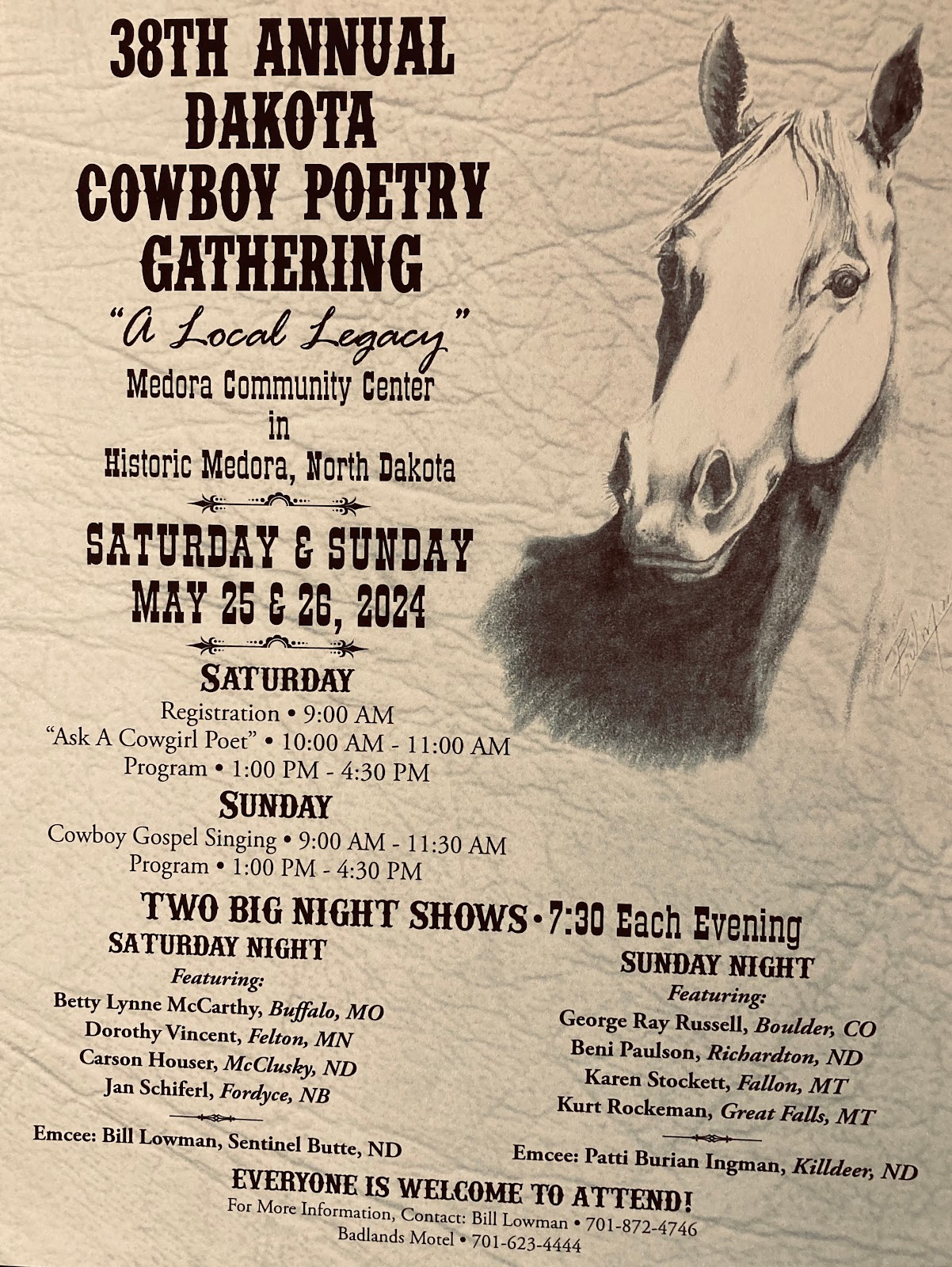
On this day in 1864 the famous railroad engineer Casey Jones was born … Minnie Pearl told of the man whose mule had such long ears that he was sawing a bigger opening in the barn door. Another came by saying why not dig a trench in this dirt floor? Because his legs aren’t too long, it’s his ears … Sheldon Lions Club will serve up brunch Sunday … I see where new bar and grille in Fort Ransom is open now … Reading Richard Lyons poems who wrote one about “Horseshoe Pitching Tournament at Sheldon” in which he starts “The pits are permanent/ The grass is green … Got an invitation again to participate in the Dakota Cowboy Poetry Gathering at Medora where it’s a good time. I’ve written a few for it: blacksmith shop, feed store, rattlesnakes, and more … adios.


Sunday, March 3, 2024

The Father of Macaroni Wheat


One day while wandering through the public radio archives of Dakota Datebook, I stumbled on a

title that made me stop and open “The Father of Macaroni Wheat.” It featured a man with the

familiar surname of Hitchcock, Charles A. Hitchcock from Buttzville who died in 1909.

To be called the father of anything besides his own children means he accomplished something

out of the ordinary. I didn’t know the story, but with a little digging it soon unfolded. In 1882 a

man named Christian came down from Canada to help with haymaking at Hitchcock’s farm. For

a reason of his own, the Canadian’s baggage included a small sack of what he called “rice

wheat.” However, he was soon called home to Canada to look after his ailing wife while leaving

something behind, that bag of wheat.

The Datebook story drew heavily from the evening edition of The Fargo Forum, January 22,

1907, which gave a more complete account. The article’s writer stated that Mr. Hitchcock threw

the sack in the corner of an old shack and promptly forgot about it. Remember the story was

written 115 years ago and the article contained what might be construed today as sexist language.

It reported, “In the spring of 1885 Mrs. Hitchcock like all good housewives was seized with one

of those characteristic feminine fits of thorough housecleaning.”

She cleaned out every nook and corner of the shanty until coming upon the sorry looking sack of

wheat on which mice had feasted. Luckily her husband interceded before she threw it away

because he was struck by the quality and large size of the few undamaged kernels. Able to

salvage about a teacup full, he planted them in his garden and harvested nearly two quarts which

he replanted next season. Those kernels yielded a bushel and a half, and he “kept on growing it

until in 1891 he harvested 1,600 bushels from forty acres.”

He shared his bounty with friends and neighbors by giving them seed to try. Roadblocks were

encountered. After selling a load to Colton’s Mill at the price of No. 1 Hard, Colton’s miller did

not succeed in making good flour. Elevators called it goose wheat and would buy it at feed prices

only. Fortunately, the local market for durum grew and thrived. In the present day North Dakota

often receives the honor for being Durum Wheat’s largest producing state.

But wait, there’s more to the story. A. H. Laughlin, the profuse historian and promoter from

Ransom County, authored the newspaper article in The Forum. We note that Laughlin was

elected Commissioner of Agriculture and Labor in 1894 from which he became a cheerleader

for the area. Was it he who hung the title of “Father of Durum Wheat” on Mr. Hitchcock?

Technically, the “father” appellation is somewhat of a misnomer since durum originally came

from Russia, and then made its way to Canada. Remember those seeds were brought by a hired

hand from Canada. Nevertheless, Hitchcock’s resolve must be credited for the interest, even

resolve, he took in propagating it in this country.We’re not done yet. There was a man named 

James A. Gates whom Laughlin called the “Father

of Macaroni Flour.” Gates, a miller, worked Colton’s mill and had set his mind to making good

flour. He succeeded in being the first miller in the region to make bread flour from macaroni

wheat. In 1889, Hitchcock took a load to him and asked Gates if he could make good flour. Gates

milled it and took a sample home to his wife who baked bread and reported it was “fine and

dandy.”

He ground nearly 2,000 bushels of it the next year for shipment, but their commission firm in

Chicago condemned it on account of its yellowish tinge. So they proceeded to sell it to local

consumers. Gates went on to work at the Walker’s mill in Fort Ransom and ground wheat to fill

their “Hold the Fort” brand flour sacks.

Local milling was common and many towns had a miller. A prominent name in the early county

history of Owego was Arntson, one of whom, Andrew, left us with written history about his

experience. In it he describes his journey by ox team: “An annual trip was made to the mill,

located at Lisbon in the fall one year, taking up a load of wheat and bringing back a year’s supply

of flour.” We learned from the quote that wheat was being sown and harvested at the early date;

pioneers worked hard at providing their own foodstuffs.

Laughlin concluded his article in the Fargo Forum by writing “The names of Charles Hitchcock

and J. A. Gates should be entered on the annals of history as public benefactors.” The Farmers

Union Grain Terminal Association saw fit to honor with a plaque stating “Charles Hitchcock in

1884 grew the first field of Amber Durum Wheat on the farm in Section 12 of Casey Township.

He thus introduced a crop of unique importance to the farmers of this state and the nation.”

Needless to say, durum makes ideal macaroni. On the backside of a box of a Creamette

macaroni box the company gave credit to Mr. Hitchcock saying what began so humbly years ago

is now the basis for several major industries that grow, process, package and ship pasta and

durum products around the world.

Random Thoughts - March 3, 2024

 RANDOM THOUGHTS - Sunday, March 3, 2024

Fifty-eight years ago a three-day blizzard struck causing the death of humans and animals and closed everything down.  … Mary talked to her cousin in Cheyenne, WY where they’re having a problem with prairie fires, too … I was greatly disturbed reading about the death of a Viet vet who called out a young man for his vulgar behavior of urinating in a public pond and was then beaten so badly he died … I enjoy reading thoughts of Chuck Haga, the retired Grand Forks Herald reporter. Among things that bother him, he stated, “Being told, sneeringly, that I am ‘Woke.’ I want to grab the pinhead and demand, ‘Say what you really mean. Do you mean you scoff at kindness and ridicule empathy? That you dismiss the idea of equality, that you find democracy laughable?’” … I used to carve a lot of these shelves in the pictures, and now don’t remember where most of them ended up …


Story Under a Stone - Vincent “Vin” Meierotto

Today we’ll salute a man I greatly admired and is deserving of inclusion here. Unfortunately, many who read this do not have a living memor...